White paper
What Changes When Metadata Has to Drive Business Outcomes?
Why approved definitions have to reach the systems that compute the answer

Finance reports one revenue number in Power BI. Sales reports another in Tableau. An AI agent asked the same question produces a third. All three sit on the same data, and each one executes a different definition.
Metadata management was built to help people understand data. Now BI tools, data platforms, and AI agents use business definitions as instructions, so the approved meaning has to reach the systems that calculate the answer.

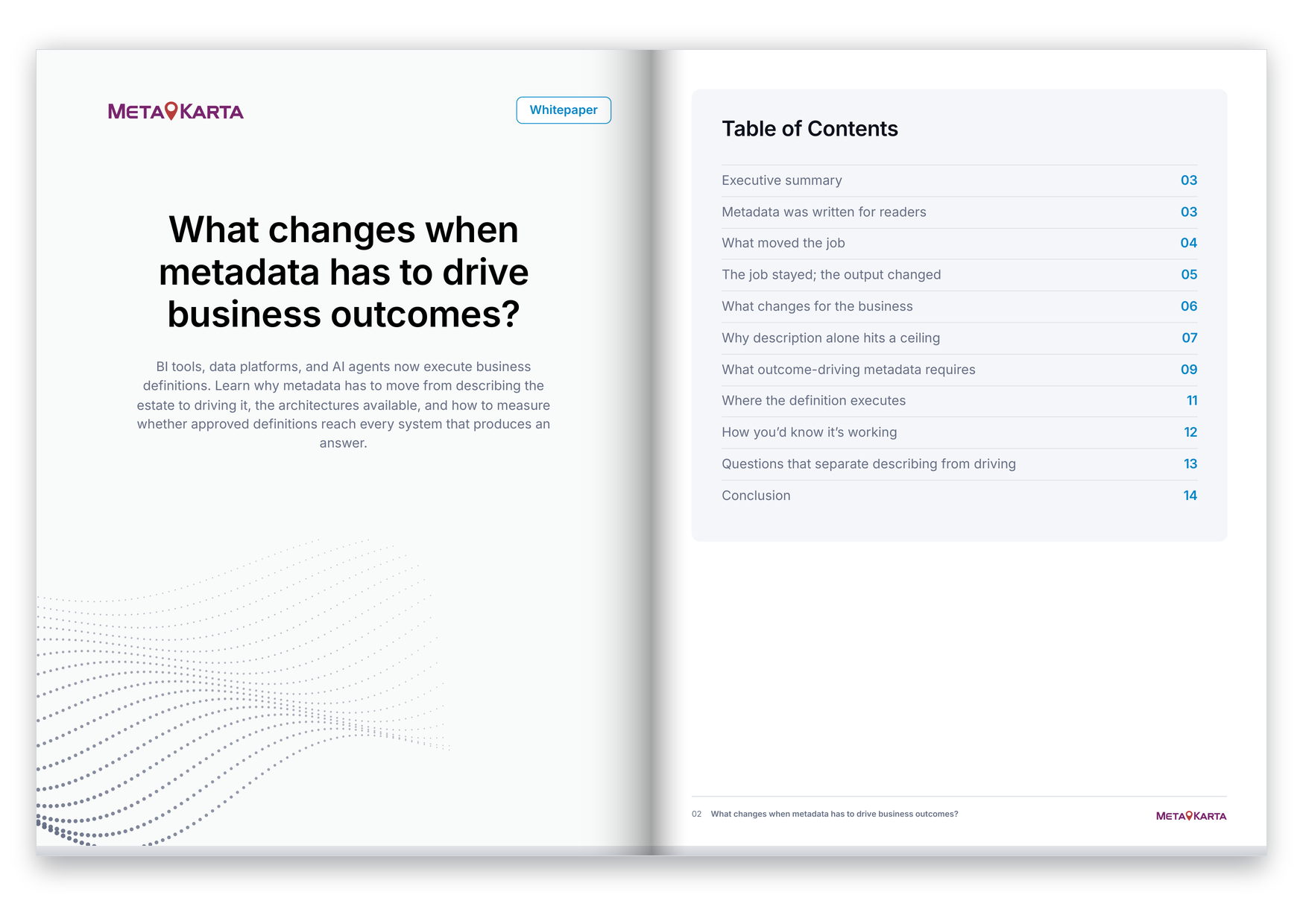
What Changes When Metadata Has to Drive Business Outcomes? White Paper
Learn what it takes for metadata to drive outcomes
Learn why description alone hits a ceiling, what outcome-driving metadata requires, and how to measure whether approved definitions reach every system that produces an answer.
- See why description alone hits a ceiling
- Cut the reconciliation tax between BI tools
- Keep embedded metric logic through BI migrations
- Ground AI answers in approved definitions
- Answer audits from versioned definitions and lineage
- Compare four architectures for delivering definitions
- Measure readiness with the Metadata Completeness Index
- Ask nine questions that separate describing from driving
Register now to get your own copy of What Changes When Metadata Has to Drive Business Outcomes?
D&A leaders must improve metadata management maturity or risk AI failure."
400+
Native Connectors
MetaKarta connects data lineage, cataloging, governance, and semantic enforcement across more than 400 enterprise systems, enabling organizations to define business logic once and deploy it consistently across warehouses, BI tools, data pipelines, and AI agents.